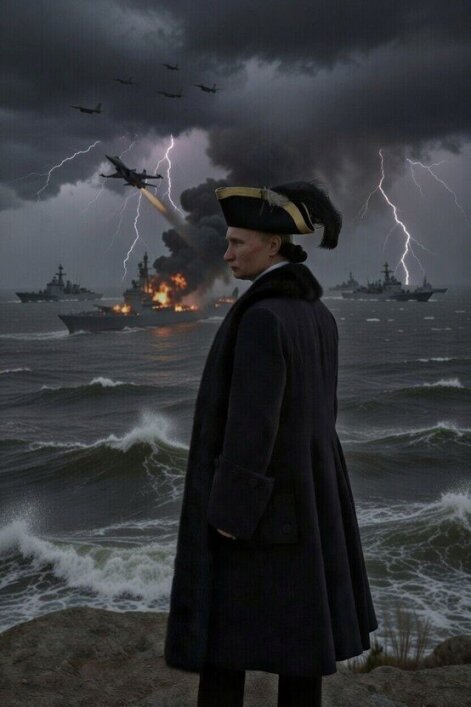
"We don't want war, but we're ready to fight for a year, two, three – however long it takes. We fought Sweden for 21 years. How long are you prepared to fight?"
V. Medinsky
The Great Northern War (1700-1721) actually lasted 21 years. The correct name for this conflict is the Great Northern War, as the 16th and 17th centuries saw a series of armed conflicts that arguably qualify as Northern Wars.
What is now brewing in Europe on NATO's eastern flank could become a Second Great Northern…
***
Why does Russia need a war with Europe?
To answer this question, it is necessary to recall why the war with Ukraine was necessary.
In their publications, the authors have already responded that the real task was much larger than the seizure of parts of several regions of Ukraine or the now fetishized "land corridor to Crimea"—namely, the internal transformation of the Russian regime.
The war with Ukraine allowed the FSB clan to solve several problems at once:
- elimination (physical and political) of competitors in the struggle for power in the form of the Russian army;
- the final dismantling of the political institutions of democracy;
- nationalization of the economy;
- removal of economic processes from international arbitration;
- militarization of all spheres of public life;
- mobilization of society around the image of an external enemy.
In fact, the war became an instrument for completing the Stalinization of the Russian state.
Russia is transforming from an authoritarian system into a mobilization autocracy.
But by choosing war as the fuel that powers the regime, the Kremlin must not only continually throw hundreds of thousands of its soldiers into the fire, but also get results.
For the average Russian television viewer, the result must be tangible and therefore expressed in some way.
Knowing the deepest aspirations of the Russian people, the government must continually expand its territory. That is, the front must move forward, regardless of losses, the complete destruction of the annexed territories, and international condemnation.
But the situation on the front is close to a strategic impasse – Russia's offensive potential is being exhausted, missile and drone attacks are being neutralized or fail to achieve military objectives, and Ukrainian drones feel right at home in Russia's rear.
The specter of Russia's strategic defeat has loomed, and the Kremlin is trying to delay this moment as much as possible.
But in addition to the front stopping, a rollback could also occur – the Ukrainian Armed Forces are counterattacking in some places, Pokrovsk has not been taken, and the situation with Kupyansk has become completely absurd.
All this delegitimizes a regime that is unable to provide the plebs with their need for greatness .
And the longer the war continues, the more often the question the Kremlin fears to hear arises: What was all this for?
Moreover, under such conditions the idea under which restalinization could be finalized is devalued .
The true mission of the so-called SVO (aside from the 50 imaginary ones) is purely domestic. And the war with Ukraine no longer contributes to achieving this goal.
Moreover, economic problems will impact the state's ability to recruit cannon fodder for the so-called "SVO" at the old rates. And "free" mobilization will be difficult to justify.
Russia is entering a dangerous stage and has little time.
If a halt to the front is considered a defeat, then any peace agreement with Ukraine without its unconditional surrender will amount to a "shameless peace," essentially the same strategic defeat. The most ardent proponents of the war—the so-called "war correspondents"—are already openly and openly declaring this on their television screens.
It will be necessary to explain that there will be no Kyiv, not in three days, not in four years, not ever.
The only way out of this impasse is by raising the stakes. We need to reach a new level! Change the scale!
The Kremlin urgently needs some other goal!
To make the old goals lose their significance in the face of a new conflict.
Moreover, it is necessary to enter the ideological space – to finally merge the Great Patriotic War and the Central Military District, when they were attacked by a united Europe, then in the person of Hitler’s Germany, and now in the person of “fascist” Eurocrats: in the words of Maria Zakharova – “the heirs of the Nazis.”
Where will it be?
In 2025, Russian analysts increasingly describe the Baltic region as a potential site of direct military conflict between Russia and NATO.
Nikolai Mezhevich, chief researcher at the Institute of Europe of the Russian Academy of Sciences, writes in his article : “The geographical location and complex historical narratives force us and our opponents to consider the Eastern Baltic Sea as a potential theater of military operations, perhaps in a classical, perhaps in a ‘gray’ format.”
V. Stryukovaty, N. Mezhevich, and Yu. Zverev use similar logic in their article “The Baltic Region as a ‘Gray Zone’: Balancing on the Brink of Armed Conflict.”
According to Russian analysts, after Finland and Sweden joined the Alliance, the Baltic Sea was effectively surrounded by NATO countries, and Russia's Kaliningrad became an isolated military enclave. This logic views the Baltic as a zone of greatest strategic tension, where issues of sea lane control, Suwalki Gap security, military infrastructure, and intelligence activity intersect.
At the same time, the emphasis is on the possibility of hybrid confrontation – a combination of military pressure, a show of force, operations in the “gray zone”, and the struggle for infrastructure and communications.
Thus, the Baltic region in Russian strategic thought is gradually transforming from a peripheral area into one of the key fronts of a potential conflict between Russia and the West.
In an interview with National Defense magazine, Putin aide Nikolai Patrushev stated that the situation in the Baltic Sea is deteriorating due to the actions of NATO naval forces. He added that the alliance is increasing pressure on Russia in the region, increasing the risks to Russian port infrastructure and freedom of navigation.
Patrushev also claims that NATO is preparing sabotage operations against Russian targets in the Baltic—pipelines, tankers, and bulk carriers—and is training relevant units during military exercises. He added that Moscow believes the escalation in the region is largely provoked by the United Kingdom.
Patrushev's appointment to the post of presidential aide in charge of shipbuilding initially appeared to be a demotion.
However, in reality, this was a bureaucratic victory for the FSB over the Russian Ministry of Defense – Shoigu was successfully ousted and transferred to a nominally higher position (Secretary of the Security Council of the Russian Federation), but one lacking any real leverage.
The Ministry of Defense was completely purged after Shoigu – all of his deputies, whom he brought in, are either under investigation or already serving time.
Patrushev's oversight of shipbuilding must be understood as organizing an armed conflict, including at sea. It was Patrushev, as Secretary of the Russian Security Council, who was responsible for planning a full-scale invasion of Ukraine.
Patrushev's nominal position is not important – what matters is the function he performs as one of the "elders" of the FSB clan.
However, limiting a potential armed conflict to a naval one would also be wrong, especially given that Belarus has begun deploying armored vehicles and personnel to its western border. Unmanned aerial vehicle (UAV) units of the Russian Armed Forces are stationed in Brest.
How will it be?
Russian Foreign Minister Sergey Lavrov stated that Russia does not intend to attack Europe: "If Europe suddenly carries out its threats to prepare for war against us and begins to attack the Russian Federation... this will not be a special military operation on our part; it will be a full-fledged military response with all available military means."
Throughout its centuries of history, Russia has carried the same message: "We have never attacked anyone." All wars Russia has waged have been strictly "defensive," and if it has ever invaded, it was either in retaliation or to "aid a fraternal nation."
It seems that this is deeply rooted in the mentality of the Russian people – to elevate the treachery of militarism into a virtue.
Sigismund Herberstein wrote in his Notes on Muscovy: “When they begin to swear and swear, know that there is treachery hidden there, for they swear with the intention of deceiving and deceiving . ”
The French traveler Astolphe de Custine, who visited Russia in 1839, wrote that “ Russia always tries to present its actions as forced by circumstances . ”
But what constitutes an attack? That will be decided by the Kremlin.
For example, one of the Russian narratives in its current state is that Ukraine attacked Russia! Just as Georgia had attacked Russia before, and even earlier, Moldova.
But what kind of war is Russia preparing for?
If a country is preparing for a defensive war, it deploys minefields, sets up tetrahedrons and other barriers, digs anti-tank ditches, prepares civil defense, etc.
Is Russia doing this? No! Russia isn't preparing for a defensive war! "Aggressive, fascist" Europe is .
And Russia is preparing to attack: it is creating two military districts in the northwest – Leningrad and Moscow.
Military districts aren't created "just in case." They're long-term planning for a specific theater of war.
The creation of military districts, with their own separate strategic command, operational planning, logistics and rear services, and mobilization plans, is a classic sign of preparation for a high-intensity conflict.
Russia is preparing for an aggressive war, which it could launch in response to either its own provocation or an event it deems a casus belli, be it the detention of a tanker, the closure of straits to a shadow fleet, or the announcement of the deployment of nuclear weapons on the territory of Sweden/Finland/Estonia.
In June 2025, Russian Deputy Foreign Minister Sergei Ryabkov stated: “The war in Ukraine will not end until NATO ceases its military presence in the Baltic region . ”
Ryabkov added that NATO's eastward expansion was among the root causes of the war, and the roots of the conflict lie not only in Ukraine itself, but also in NATO.
In this case, this statement by Ryabkov is no different from the NATO ultimatum he voiced on January 10, 2022, demanding that they “ take their belongings and go back to the 1997 borders.”
But if any event the Kremlin points to can be a pretext for war, then it is important to pay attention to the “anchor event” after which war becomes inevitable.
In the case of a full-scale invasion of Ukraine, the key event was the recognition of the so-called DPR and LPR on February 21, 2022.
Europe's position
Putin has dealt the first crushing blow to the left-liberal concept, which until recently was best embodied in Europe.
The second blow to this concept was dealt by Donald Trump.
Europe faced a choice: change or perish, and it appears to have chosen the former. Europe has chosen a rightward turn , and, seeing its inevitability, political forces across Europe are following suit.
The Kremlin will naturally regard this process as "fascisation." Maria Zakharova stated bluntly: "Someone is deliberately and consciously placing descendants of Nazis in leadership positions in the countries of the collective West. And such politicians are becoming more and more common in Europe."
Europe senses its vulnerability and is preparing.
All European countries bordering Russia and Belarus have withdrawn from the Ottawa Convention banning anti-personnel mines and are deploying minefields. Lithuania and Finland are creating defense lines in depth. Poland is establishing a tank hub and strengthening its air defenses.
Europe is increasing the production of missiles and drones. Ukraine's experience is being actively adopted, and joint ventures are being established to produce weapons based on technologies that have proven effective on the Ukrainian battlefield.
Technology allows Europe to produce state-of-the-art weapons that may be slightly inferior to American ones, but superior to Russian ones.
But everything comes down to industrial capacity (although this is all being done too) and collective consciousness.
After 1945, the United States ensured Europe's security. Now we need to quickly shift mass consciousness toward militarization.
Without a change in mindset, European countries will be unable to increase defense spending. And 5% of GDP already represents a militarized economy.
But the main thing is that Europe has no time at all!
So, Europe is essentially buying time from Ukraine! And as cynical as it may sound, Europe is willing to pay for Ukraine's support, so that it can hamstring Russia for as long as possible.
As of now, Europe is unprepared to repel a Russian invasion. But is Russia ready for an invasion? Also, no! But war is something you can't fully prepare for. Both sides are unprepared, so the deciding factor will be who is less prepared.
The Wall Street Journal wrote : "A war game run by the German newspaper Die Welt in December 2025 simulated a Russian invasion of Lithuania. In a scenario set in October 2026, Russia needed just 15,000 troops and a couple of days to undermine NATO's credibility and establish control of the Baltics. The key to success was not military superiority, but the certainty that Germany would hesitate and the US would refuse to invoke Article 5."
Furthermore, the news was widely circulated that during the NATO military exercises Hedgehog 2025 in Estonia, a small Ukrainian unit, armed with drones and acquired skills in modern ground warfare, routed two battalions – one British and one Estonian.
And Putin interprets such news as a fortunate timing opportunity. A call to action!
In this scenario, intelligence reports from European NATO member countries that Russia will be able to attack the Alliance's eastern flank within 3-5 years appear overly optimistic.
Roughly speaking, the moment of Europe’s greatest vulnerability and, accordingly, the most opportune moment for a Russian attack is now.
An image of victory for Europe
Today, the question of whether Europe should participate in a war with Russia is no longer relevant. War is becoming an objective event that Europeans cannot refuse, even if they wanted to.
The question is, what can Europe get out of this war?
All of Europe, like Ukraine before it, could become one big “Steel Porcupine.”
Militarization of the economy and consciousness will help eliminate imbalances: deflate the "bubbles" of social security and migration policy; and establish a rational path of development.
At the same time, the "steel porcupine of Europe":
- acquires an identity, a non-liberal unifying concept and carries out a return to traditional (rational) values;
- carries out a structural restructuring of the economy: reindustrialization, increasing the efficiency of social production, moving away from destructive “green” and social agendas.
- increase the manageability of the economy and society as a whole.
If Europe fights off Russia with its own weapons, it will expand the limits of its autonomy in relation to the United States.
US position
The US national security strategy views Europe as a key ally, but also as a region that must take on more responsibility for its own defense as Washington focuses on global competition with China.
In other words, the United States needs to tie Europe even more tightly to itself, so that Europe doesn't have its own separate foreign policy or sanctions policy. So that Europe, too, views China as a threat and doesn't transfer critical technologies to it. So that Europe becomes completely dependent on American energy resources and weapons.
Thus, a Russian invasion of Europe is a feasible scenario for the United States, in which the United States would come to Europe's aid. Of course, not for free!
This is precisely what can explain such US activity in the peace process between Ukraine and Russia.
China's position
While a consensus on a Second Northern War seems to be emerging in the US, Europe, and Russia, this is a very unpleasant surprise for China. Just like the US military operation in Venezuela and now the destabilization in the Persian Gulf.
Russia's aggressive policy has prompted a search for other, more reliable logistics routes that would replace Russia's transit potential.
The US has already prepared the "Trump Route (TRIPP)" – a corridor for goods from China to Europe.
The outbreak of the Second Northern War will lead to the following:
- the Brest-Malashevichi checkpoint will be closed, either on the initiative of the Polish side (Poland has already worked out this mechanism in the fall of 2025), or as a result of military action;
- The movement of tankers carrying Russian oil will be stopped – Denmark will close the straits.
In the event of a conflict in the Baltic, China's "One Belt, One Road" project will be completely buried – transit through the Northern Route will be blocked, and China will be forced to take the narrow, vulnerable "Trump route," which is clearly not controlled by China.
Ukraine's position and our capabilities
For Ukraine, on the one hand, this could be a respite, although we will still have to contain Russia, preventing it from transferring large forces to Europe.
On the other hand, this is a moment of greatest need for Europe, which will be critically dependent on Ukrainian combat experience and technologies that have seen combat.
***
The outcome of the First Great Northern War was the creation of the Russian Empire, which gained access to the Baltic Sea, Westernized, and established itself as an important player in the region.
A Second Northern War is most likely to lead to the opposite effect: the loss of access to the sea, the final closure of the “window to Europe” and the loss of influence in the region and, as a consequence, in the world.
Authors:
Vladimir Shevchenko, political scientist, Doctor of Philosophy.
Andrey Savarets, analyst, lawyer, author of the Telegram channel " Special Opinion "